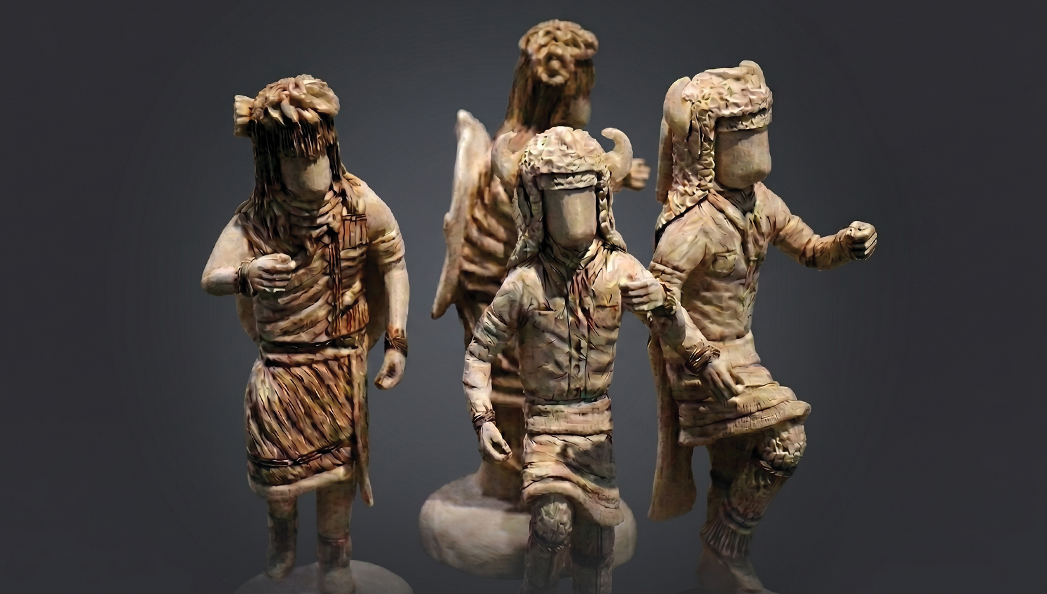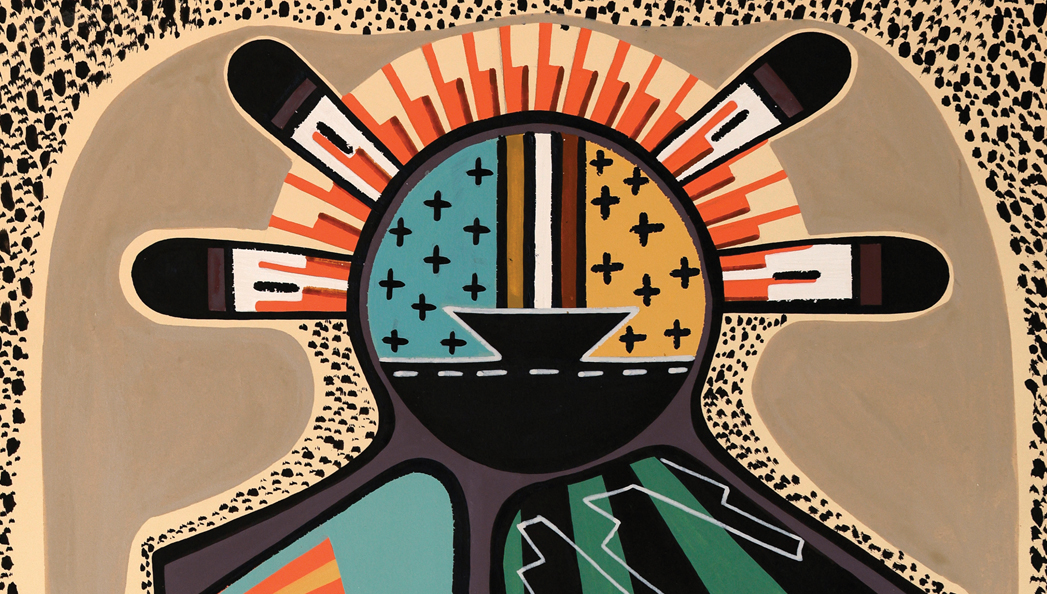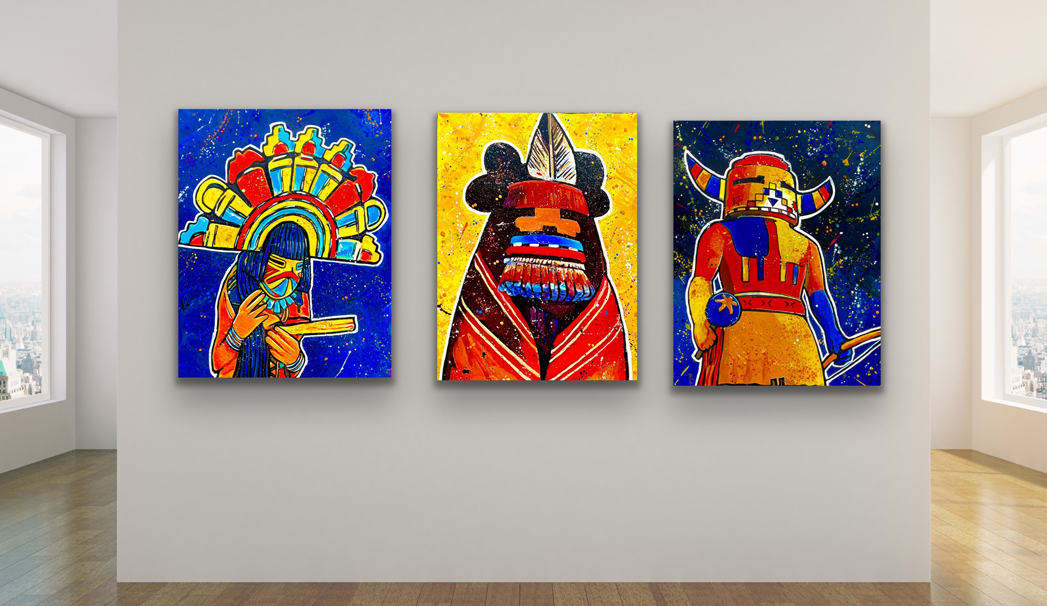
Meet two award-winning Hopi carvers who advance the art of the katsina BY ERIKA AYN FINCH; PHOTOGRAPHS BY DEBBIE WEINKAUFF The word “kachina” comes up often in the Southwest, commonly understood to refer to small dolls created by Native American artists from cottonwood root. They make for popular gifts, but many visitors are unaware of their real significance in Native American culture. The dolls, as associated with the Hopi people (the Zuni also carve dolls for religious ceremonies), are called tithu – they represent katsinam, spirit beings that visit the Hopi mesas in northern Arizona in the form of clouds from the winter to the summer solstices. There are several hundred katsinam (in the singular, each is a katsina) representing plants, animals, insects, and human qualities. There are clown katsinam that entertain, and demons that frighten children into behaving (our personal favorites); most are messengers between the Hopi and the gods. At private Hopi ceremonies and dances performed for katsinam, infants, young girls, and women receive katsina dolls. Newly arriving settlers in the southwest mispronounced katsinam, turning it into kachina. In modern Hopi culture, the dolls are referred to as katsina. To learn more, we met with two award-winning Hopi katsina carvers. Gerry Quotskuyva carves dolls in a contemporary style. Kevin Sekakuku carves traditional and contemporary katsina – when we spoke, he was still aglow after winning three ribbons at the 2007 Santa Fe Indian Market. We also spoke with the three women who own Kachina House in West Sedona, who share insights into the business of buying, selling, and collecting katsina. Gerry Quotskuyva Born in Winslow and raised in Flagstaff, Gerry didn’t begin carving katsinas until he was in his mid-30s – prior to becoming an artist he says he was a “professional student” and worked as a caterer for a Los Angeles company (he worked on the sets of John Landis’ ¡Three Amigos! and Clint Eastwood’s Heartbreak Ridge in the mid-1980s). At a time when he was short on cash he began crafting medicine wheels and shields for Stuckey’s, a chain of roadside stops with gift stores. At one point he was creating 2,100 units per month, so with his income from Stuckey’s as a cushion, he opened a shop in Old Town Cottonwood. As fate would have it, shortly after opening GQ’s in the early 1990s, Gerry lost the Stuckey’s account. But he noticed an interesting trend at the store: Several customers asked him for katsina dolls. One day he found a pocket knife in his truck, picked up a piece of cottonwood root, and carved three dolls after he dreamed of katsinas flying from ears of corn, the corn husks turning into their robes. One of those first three dolls, Corn Maiden, is currently in the hands of a Sedona business owner. Gerry closed the Cottonwood shop and focused on his carving, selling the dolls at regional Indian markets and to galleries in Sedona, Prescott, and Flagstaff. Gerry’s katsinas, both his full-figure dolls and sculptures, are in a contemporary style – he uses bright-color acrylic paints and a wood-burning technique for texture in hair and on jewelry. Some of his dolls are carved from one piece of cottonwood root while others come from several pieces. (For years, collectors insisted dolls be carved from one root but Gerry says there’s no historical significance to one-piece dolls in the Hopi culture – nails can be seen in old dolls on display in museums.) All katsinas represent cloud deities and Gerry’s dolls wear capes and robes that bell out at the bottom, representative of the evaporative process. Their capes are all open on one side to release the spirit or heart of the piece. The forward foot, visible hand, and broad shoulders are the embodiment of the soul. Gerry tends to stick with more common katsinas such as Crow Mother, Sunface, and various ogres. He says some of his dolls, including Corn Maiden and Butterfly Maiden, are more like artistic interpretations of katsinas. “A lot of people weren’t sure about my work,” he says. “It was so different. I didn’t step over the line but I came close to the edge. But I took my first Corn Maiden to my grandfather for approval and he loved it.” In 2000 Gerry opened a booth at Artmart in West Sedona (fun fact: Gerry and his wife, artist Debbie Menig, created the carvings on the building’s façade) and was part of the Sedona Artists Studios at Hozho Center for several years before he opened Pueblo Sedona gallery at Hozho in October 2002. “I struggled as an artist but my career took off in Sedona and I’m thankful for that,” he says. The couple closed the gallery in 2007 and Gerry now sells his katsinas online (www.gquotskuyva. com), at Garland’s Indian Jewelry and Garland’s Navajo Rugs in Sedona, and the Heard Museum Shop in Phoenix. Gerry also works on many commissions. At carving time, Gerry says he lets the wood speak to him. He carves daily in a travel trailer in his backyard using an Old Timer knife (“My $9.95 blue light special,” he laughs), working on several dolls at once. “I treat the dolls like children and, like a family, one doll might need more attention than another,” he says. “I had one I was using as a doorstop for years until a woman came by and asked, “How much for the doorstop?” I finished [the katsina] at that point. Until then, she didn’t want to be finished. I was not yet the caliber she wanted me to be.” Gerry agrees that contemporary-style Hopi katsina dolls began as a way to sell dolls to the public, but adds that view has begun to change. Now, it’s not unusual to walk into a home on the reservation and see contemporary dolls on a shelf or even to attend a ceremony where contemporary dolls are used. He’s diplomatic when the subject of Navajo kachina dolls comes up. The Navajo create and sell kachina dolls though the dolls have no historical importance to the tribe. “There was a lot of animosity when the Navajo started making dolls but I try to see the positive side in everything,” says Gerry. “Before the Navajo it was unheard of to find a Hopi katsina selling for $1,000 or more. It’s also forced [serious] collectors to become educated.” Kevin Sekakuku “I heard about the [Santa Fe] Indian Market and realized there was a whole world for Indian arts,” says Kevin, wearing turquoise jewelry and seated at the patio of the Heard Museum in Phoenix, near his home. “This was in the early 1990s. I knew that one of these days I’d be in that show.” His vision came true; he’s since brought home numerous ribbons from Santa Fe, widely considered the world’s most prestigious Indian arts show. He admits he was “overwhelmed” during his first time at Indian Market but on his second visit he won an honorable mention. Last year, his Awatovi Soyoktaka Ogre with Warrior Twins, a 15-inch tall traditional katsina decked out in leather, abalone, seashells, feathers, and horsehair, won first place in two categories (another of Kevin’s contemporary katsinas won first place in its category). Kevin has been entering shows almost since he began carving – when he was in elementary school he won first place in his age division at the Heard Museum Student Art Show. After boarding school he returned to the reservation and began selling his katsinas to galleries in Sedona and at art shows in Phoenix and Flagstaff. Currently, his work can be found at Garland’s Navajo Rugs and Kachina House in Sedona as well as galleries and museums in Phoenix, Flagstaff, Scottsdale, Colorado, Utah, Santa Fe, San Diego, and Chicago. Until three or four years ago he focused on contemporary carvings but he says people began asking about traditional katsinas. At first Kevin thought they would be easy but quickly learned otherwise.“The traditionals are more primitive,” he says. “They take me back home and remind me of preparing for ceremonies.” Today, he uses cottonwood root he gets from a friend living in Glenwood Springs, Colo. He says selecting the wood is the first step – if the wood has a few cracks it’s better suited for a traditional carving for a “prehistoric look.” He carves the piece with a pocket knife, sands it, glues on eyes and ears, and then white-washes the carving with a Hopi clay called tuma, which helps the paint stick to the wood. Kevin mixes his own paints using natural pigments and then mutes the colors with another coat of tuma. At the finish, he adorns the doll with goat fur, rabbit skins, raw cotton, horsehair, macaw or fowl game feathers and other accoutrements including seashells, cornhusks, Hopi grasses, yucca, leather, and sumac. Some of Kevin’s most popular dolls include Cold Bringing Woman, Eagle, Sunface, Water Maiden, and his mudheads. He carves cradle dolls, particularly for art shows, since they tend to be the most affordable, and enjoys commissions (contact him at kevinsekakuku@yahoo.com). Kevin says he carves every day, even during shows. “My grandfather told me if you aren’t doing something people will think you are a lazy person,” he says. “People tell me I should take a break but I have to have a knife and piece of wood in my hand, ever since I watched my uncles.” When Kevin first moved to the Valley he drove for a transportation company for about a year but has basically made a living with his art since the late 1990s. He has two children – a daughter who has a large collection of Kevin’s katsinas and a 3-year-old son who’s learning the craft (in Hopi tradition, men carve the katsinas). He says his parents, who still live on the reservation, are “blown away” by his art – his mom has Kevin’s first sculpture, first full-figure doll, and first flat doll. “I feel very fortunate to be able to raise my family off my artwork,” he says. “It was hard to get where I am now but I appreciate the struggle. It has made me stronger.” Friends have urged Kevin to try stone sculpting and he says he’s thinking about it. He’s tried his hand at silversmithing (his father, Sydney Sekakuku, is a master), weaving, and pottery, and he’s in a drum group called Thunder Boy, which hopes to release a CD this fall. While he loves to try new things, Kevin says he’ll always come back to his pocket knife and a piece of cottonwood root. “I don’t think I could do anything else.” • A Visit to Kachina House Contemporary katsinas came about as a way for Hopi carvers to make money selling to Anglos, while traditional katsinas saw a surge in popularity in the 1930s and 1940s. About 20 years ago, “new traditionals” hit, largely due to carver Manuel Denat Chavarria Jr. Patty says the most popular katsinas are Eagle, who communicates with the gods, and Sunface, who harnesses the sun’s power. Patty says customers will come to Kachina House looking for katsinas that will bring love or money, but those dolls don’t exist. “Katsinas bring food, warmth, fertility of crops and people, sun, rain, and health,” she says. “Corn Maiden brings corn and harvest, things we don’t think about. We think about putting gas in our car.” Hopi carvers stop by Kachina House on a regular basis with dolls for sale – Patty, Toby, and Judy rarely go up to the reservation unless it’s to attend a ceremony. Though some carvers don’t like the fact that Kachina House sells Navajo kachinas, Patty says Navajo dolls should not be dismissed completely. “Basically, the Navajo took the tradition from the Hopi and use manufactured pieces,” Patty explains. “They have no spiritual meaning – they are souvenir dolls. But they are less expensive than Hopi dolls. Some collectors start with Navajo dolls and work up to Hopi pieces – not everyone can afford a Jaguar or Mercedes, and in this shop we have something for everyone. But we do keep the Navajo and Hopi katsinas separate.” The Hopi aren’t the only tribe to use katsinas in religious ceremonies – the Zuni also carve but, Patty says, she’s never heard of Zuni katsinas being sold to the outside world. With demand up dramatically in recent years, fake katsinas from China have hit the market, and some knock-offs are skillfully done; Kachina House had three in house before they realized it. “Before long fake katsinas will be as common as fake jewelry,” Toby says. The best advice Patty, Toby and Judy can offer is to buy from reputable dealers and educate yourself. Becoming knowledgeable is a major part of the Kachina House experience – during our visit, Toby was leading a group on a tour of all the rooms. The women also advise customers to buy katsinas because they are meaningful to them, rather than as an investment. “Buy it because you love it, not because you think it will be worth something 20 or 30 years from now,” says Patty. “No one knows which ones will be worth the most.” Kachina House
|


I was born Hopi so I was born with a paintbrush in my hand – it’s our cultural responsibility to create products used in ceremonies,” says Gerry Quotskuyva, seated at his kitchen table in his adobe-style home in Rimrock, three of his brightly painted katsina dolls displayed in front of him. “When you live on the reservation your influence comes from your religion but when you grow up off the reservation, like I did, you have more individuality. I wanted to create something I could showcase.”
When he was 7 years old, Kevin Sekakuku would sit under a shade tree outside his grandmother’s house on the Hopi Reservation and watch his uncles carve katsinas. In no time he was carving flat cradle dolls – he gave his first one to his mom who still cherishes it – and by age 10 he was crafting full-figure pieces. But he says he didn’t really get rolling until he attended boarding school in Santa Fe in his mid-teens.